

 |
| Indonesian Era |
Hindu and Buddhist kingdoms era
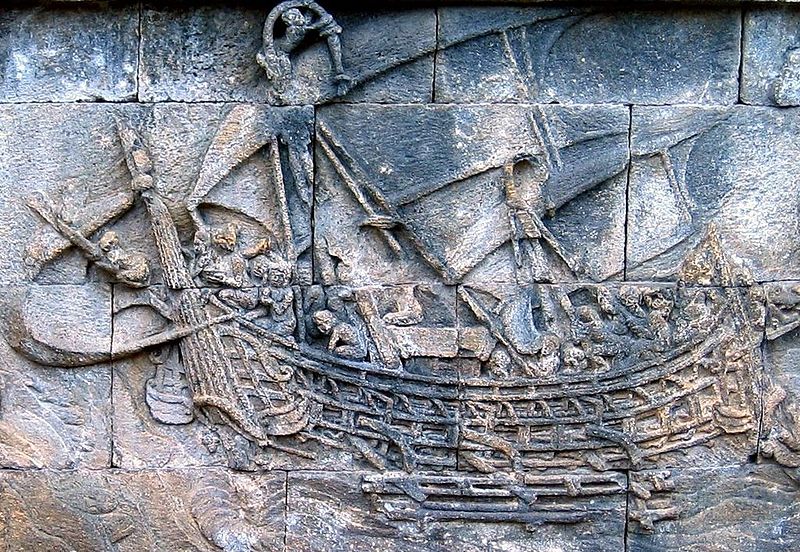
Hinduism and Mahayana Buddhism arrived in Indonesia in the 4th and 5th century, as trade with India intensified under the southern Indian Pallava dynasty. This is evidenced in the Kutai, Tarumanagara, and Kantoli kingdoms of the period. From the 7th century to early 11th, the powerful Srivijaya naval kingdom become a hegemon in Southeast Asia and flourished as a result of trade and the influences of Hinduism and Buddhism that were imported with it. Srivijaya's main foreign interest was nurturing lucrative trade agreements with China which continued from the Tang dynasty to the Song dynasty. Srivijaya had religious, cultural and trade links with the Buddhist Pala Empire of Bengal, as well as with the Islamic Caliphate in the Middle East. The necessity to maintain its trade monopoly had led the empire to launch naval military expeditions against rival ports in Southeast Asia and to absorb them into Srivijaya's sphere of influence.
 |
| Javanese gold artefacts |
The port of Malayu in Jambi, Kota Kapur in Bangka island, Tarumanagara and the port of Sunda in West Java, Kalingga in Central Java, the port of Kedah and Chaiya in Malay peninsula are among the regional ports that were absorbed within Srivijayan sphere of influence. A series of Javan-Srivijaya raids on the ports of Champa and Cambodia was also part of its effort to maintain its monopoly in the region by sacking its rival ports.
 |
| Chola Empire Temple |
After the invasion by Rajendra Chola I the king of the Chola Empire from Koromandel, authority of Srivijaya over the islands of Sumatera and the Malay Peninsula weakened. Some time later came a new dynasty that took over the role of Sailendra Dynasty, called by the name of Mauli dynasty. Mauli dynasty of Malay kings that rules Dharmasraya kingdom, centred in Batanghari river system. In later period of the kingdom's capital shifted inland upstream of Batanghari to Dharmasraya and later moved further inland to Pagaruyung.
 |
| Borobudur Temple |
Between the 8th and 10th centuries, the agricultural Buddhist Sailendra and Hindu Mataram dynasties thrived and declined in inland Java, leaving grand religious monuments such as Sailendra's Borobudur and Mataram's Prambanan. The Hindu Majapahit kingdom was founded in eastern Java in the late 13th century, and under Gajah Mada, its influence stretched over much of Indonesia.
The founder of the Majapahit, Kertarajasa, was the son-in-law of the ruler of the Singhasari kingdom, also based in Java. After Singhasari drove Srivijaya out of Java in 1290, the rising power of Singhasari came to the attention of Kublai Khan in China and he sent emissaries demanding tribute. Kertanagara, ruler of the Singhasari kingdom, refused to pay tribute and the Khan sent a punitive expedition which arrived off the coast of Java in 1293. By that time, a rebel from Kediri, Jayakatwang, had killed Kertanagara.
 |
| Kertanegara of Singhasari |
The Majapahit founder allied himself with the Mongols against Jayakatwang and, once the Singhasari kingdom was destroyed, turned and forced his Mongol allies to withdraw in confusion. After its peak in the 14th century, Majapahit power began to decline and was unable to control the rising power of the Sultanate of Malacca. Dates for the end of the Majapahit kingdom range from 1478 to 1520. A large number of courtiers, artisans, priests, and members of the royal family moved east to the island of Bali at the end of Majapahit power.
Next we discussion about Indonesian Islamic Era.


 Posts
Posts


No comments:
Post a Comment